

At a glance
Population
1,265,936
Region
Prairie provinces
Capital
Regina
Largest city
Saskatoon
Land area
577,060 km²
Highest point
Cypress Hills, 1,392 m
Established
Sept. 1, 1905
Time zone
CST (UTC−6), no daylight saving
Official language
English
Official bird
Sharp-tailed grouse
Official flower
Western red lily
Official tree
White birch
Population: Statistics Canada, Table 17-10-0009-01, Q1 2026 · Land area: Statistics Canada, Table 98-10-0001-01, 2021 Census · Symbols: Government of Canada, Canadian Heritage · Highest point: Natural Resources Canada, Geographical Names Data Base
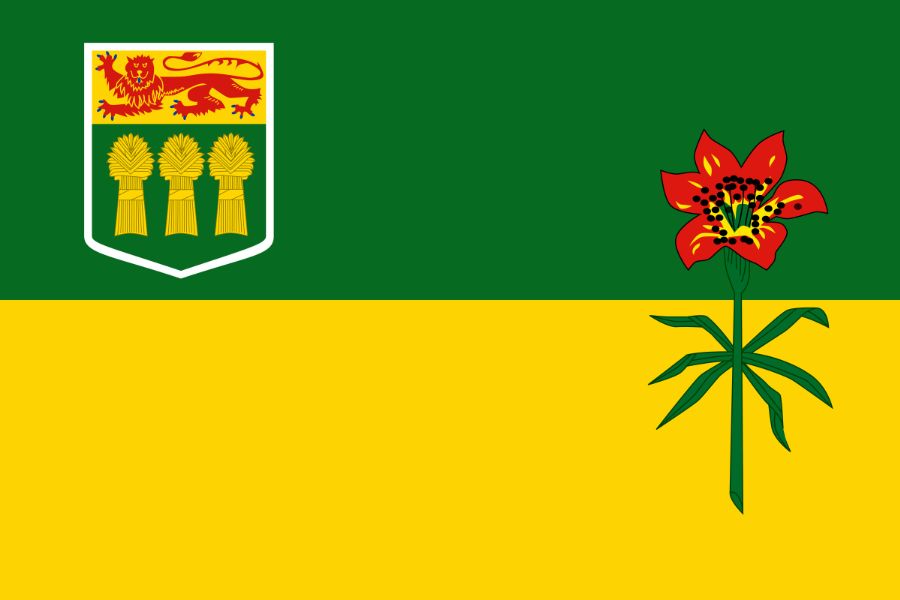
About the flag
- •Adopted in 1969, proclaimed by the lieutenant governor following approval by the legislative assembly
- •Divided horizontally into two equal halves: green for the northern forests, gold for the southern grain fields
- •The Saskatchewan shield of arms appears in the upper left quarter near the staff; the western red lily, the provincial flower, is on the fly half
- •Proportioned two parts long to one part wide
- •The design was created by Anthony Drake, an English teacher who came to Saskatchewan in 1967 and taught in Hodgeville. His submission was chosen from entries in a provincial design competition. He and his wife returned to England in 1969, the same year the flag was proclaimed.
Did you know?
- •First in flight: Regina holds several firsts in Canadian aviation history. In 1920, its Lakeview District airfield became Canada's first licensed air harbour, and local resident Roland Groome received Canadian Commercial Pilot's Licence No. 1. The city was also the launch point for the Saskatchewan Air Ambulance in 1946 — the oldest formally organized, non-military air medical transport program in North America. Its first flight went from Regina to Liberty, Saskatchewan.
- •Purple sand: Along the northeastern shore of Candle Lake, garnet carried south by glaciers during the last ice age has created one of the world's rare purple sand beaches. The sand ranges from lavender to magenta depending on wave action and season.
- •The name: Saskatchewan takes its name from the Cree word kisiskāciwani-sīpiy, meaning swift flowing river, the name given to the Saskatchewan River long before European contact.
- •Dark sky: Saskatchewan has two designated dark sky preserves. Grasslands National Park holds some of Canada's darkest skies, and Cypress Hills Interprovincial Park, straddling the Alberta-Saskatchewan border, was the first shared dark sky preserve in Canada when it was designated in 2004.
- •Wanuskewin: Just north of Saskatoon, Wanuskewin Heritage Park is a national historic site and UNESCO World Heritage nominee that has been a gathering place for Northern Plains Indigenous peoples for more than 6,000 years. It contains 19 pre-contact archaeological sites, a medicine wheel, bison jumps, and the longest-running archaeological dig in Canada.