

At a glance
Population
867,383
Region
Maritime provinces
Capital
Fredericton
Largest city
Moncton
Land area
71,249 km²
Highest point
Mount Carleton, 817 m
Established
July 1, 1867
Time zone
AST (UTC−4) / ADT (UTC−3)
Official languages
English and French
Official bird
Black-capped chickadee
Official flower
Purple violet
Official tree
Balsam fir
Population: Statistics Canada, Table 17-10-0009-01, Q1 2026 · Land area: Statistics Canada, Table 98-10-0001-01, 2021 Census · Symbols: Government of Canada, Canadian Heritage · Highest point: Natural Resources Canada, Geographical Names Data Base
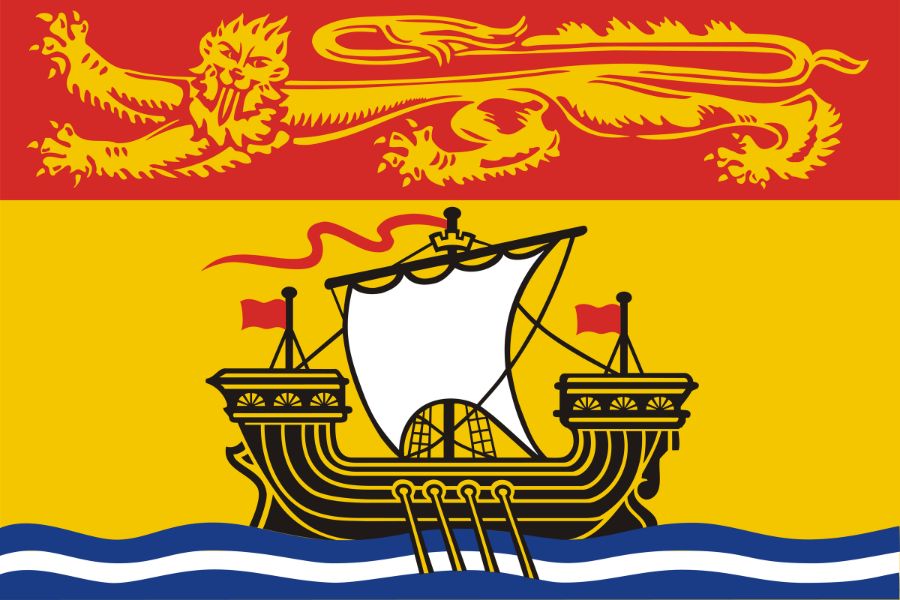
About the flag
- •The flag is based on the provincial coat of arms, assigned by royal warrant of Queen Victoria in 1868, and was adopted by proclamation in 1965
- •The gold lion on a red field reflects New Brunswick's connection to both the Duchy of Brunswick in Germany and to England. When the province was established in 1784, the Duchy was in the possession of King George III
- •The galley in the lower half is the conventional heraldic representation of a ship, reflecting the two principal economic activities of the province when the coat of arms was assigned: shipping and shipbuilding
Did you know?
- •Bilingualism: New Brunswick is the only constitutionally bilingual province in Canada, with both English and French as official languages.
- •The reversed river: Twice a day, the Bay of Fundy's tides rise so high they overpower the current of the Saint John River, forcing it to flow backwards. The effect is felt as far upriver as Fredericton, almost 120 kilometres from Saint John.
- •Mount Allison: In 1875, Mount Allison University in Sackville became the first university in the British Empire to award a bachelor's degree to a woman. Grace Annie Lockhart, a Saint John native, graduated with a Bachelor of Science and English Literature.
- •Covered bridges: New Brunswick is home to more covered bridges than any other province in Canada. The province once had more than 300; fewer than 60 remain, each one a working piece of history on a back road somewhere in the province.
- •Old Sow: The largest tidal whirlpool in the Western Hemisphere, and second largest in the world, churns off the southwestern tip of Deer Island near Eastport, Maine. Known as Old Sow, it is powered by the same tides that make the Bay of Fundy famous.